Boston-area Iranians react to escalating Iran conflict with family fears, political divides, and uncertain expectations
A community split between alarm for relatives and hopes for political change
Boston-area residents with ties to Iran are navigating rapidly shifting developments in the widening conflict involving the United States, Israel, and Iran, while trying to reach family members amid reported communications disruptions inside Iran. Across Greater Boston, reactions have ranged from grief and anxiety to guarded optimism, reflecting different experiences with Iran’s government and contrasting views on outside military intervention.
The latest escalation followed coordinated U.S.-Israeli strikes that were widely reported to have killed Iran’s supreme leader, Ayatollah Ali Khamenei. Iranian retaliation has included missile and drone attacks aimed at Israel and U.S.-aligned targets across the region, with Gulf states reporting damage and casualties. U.S. officials have reported American service-member deaths tied to the expanding hostilities.
Fear sharpened by blackout conditions and distance
For many Iranian Americans, the most immediate concern has been the safety of relatives in Iran and the uncertainty created by intermittent connectivity. Local residents described periods in which family communication became difficult or impossible, leaving them to rely on fragmented information about conditions on the ground.
At businesses and gathering places that serve the local Persian community, conversations have centered on whether loved ones can safely shelter, whether travel is possible, and what further escalation could mean for civilians. Some residents said they had last heard from family members as strikes were beginning, before lines of communication went quiet.
Public celebrations and protests in Greater Boston
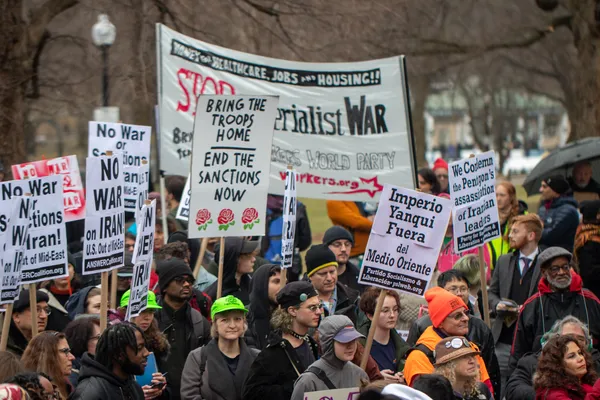
Public demonstrations in Boston highlighted divergent political reactions. Some gatherings featured pre-1979 Iranian flags and expressions of support for regime change, while other rallies condemned the strikes as unlawful and warned of civilian harm and long-term instability. Participants included immigrants who left Iran in recent years as well as Iranian Americans whose families have lived in the United States for decades.
Several Boston-area residents said their views were shaped by personal histories that include arrests, participation in protests, or the loss of friends in earlier demonstrations. Even among those who favor fundamental political change in Iran, some expressed apprehension about the human cost of a widening war and the unpredictability of military-led outcomes.
Political fallout reaches Congress as hostilities expand
The unfolding conflict has also intensified debate in Washington over presidential war powers and the scope of U.S. military action without explicit congressional authorization. In Massachusetts, Democratic leaders have publicly criticized the strikes and urged limits on further escalation, framing the issue as both a constitutional question and a matter of U.S. national interest.
- Local families report renewed anxiety over relatives’ safety and limited communications inside Iran.
- Boston-area demonstrations have reflected sharply different views on intervention, legality, and regime change.
- Regional retaliation has widened the conflict’s footprint, increasing uncertainty for civilians and diaspora communities alike.
Across the Boston region, Iranian Americans described the same moment in starkly different terms: for some, a possible turning point; for others, an immediate threat to family members and a warning of protracted instability.
With the regional picture still evolving day by day, many in Greater Boston said they are bracing for more disruption while watching closely for signs of de-escalation, internal political shifts in Iran, or deeper U.S. involvement.