How Reggae the harbor seal uses rubber ducks in daily enrichment training at Boston’s aquarium
A familiar toy, built into a structured routine
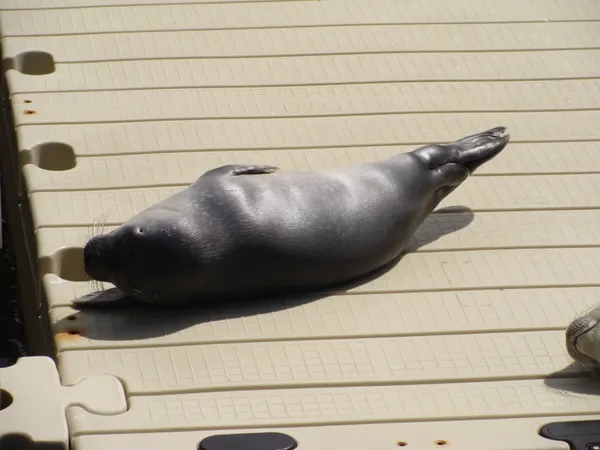
At the New England Aquarium’s front plaza exhibit in Boston, an Atlantic harbor seal named Reggae has become closely associated with an unlikely training tool: rubber ducks. The objects are used during daily enrichment sessions designed to keep animals in human care mentally engaged while reinforcing learned behaviors and responsiveness to trainers’ cues.
In these sessions, trainers place multiple rubber ducks in the water and use verbal prompts and hand signals to direct Reggae to locate, approach, nudge, retrieve, or hold specific items. Trainers also reward correct responses with small pieces of fish. The work is designed to reinforce attention, memory, and task completion while encouraging natural movement through the habitat.
What “enrichment training” aims to accomplish
Enrichment is a standard component of modern marine mammal care, used to provide variety and challenge beyond routine feeding and health checks. At the Aquarium, enrichment activities are integrated into a broader husbandry approach in which seals are trained to participate in their own care. The goal is to support physical activity and cognitive engagement while maintaining predictable, low-stress interactions with staff.
Rubber ducks are one of many potential objects that can be introduced into a seal’s environment. Their small size and buoyancy allow trainers to create tasks that involve visual searching, swimming to targets, and manipulating objects with the mouth or front flippers. The same objects can be repositioned or swapped to change the difficulty and novelty of a session without altering the broader routine.
Reggae and the Aquarium’s long-running harbor seal program
Reggae is part of a multigenerational group of Atlantic harbor seals housed in a 42,000-gallon outdoor exhibit designed to resemble a rocky New England shoreline. The exhibit is among the Aquarium’s most visible public-facing habitats, positioned on the front plaza and frequently drawing crowds along the Harborwalk.
The Aquarium’s current harbor seals were born under human care, including animals connected by lineage to Hoover, a well-known harbor seal that gained national attention decades ago for mimicking human-like phrases. Staff have said that structured training, daily enrichment, and veterinary oversight have contributed to seals living beyond the species’ typical wild lifespan of roughly 25 years, with several individuals surpassing 30 and 40 years.
How a viral moment intersects with animal care
Recent public attention intensified after Aquarium video showed Reggae floating while tightly holding a duck against his body and later resting with a duck tucked under a flipper. While the images read as playful, the underlying behaviors align with a training framework that uses simple objects to keep routines varied and animals responsive.
- Multiple ducks can be used to build discrimination tasks (responding to a specific target).
- “Hold” behaviors encourage controlled positioning and sustained focus.
- Object work can be adjusted daily to balance familiarity and novelty.
In practice, a rubber duck functions less as a toy and more as a movable target that supports consistent training goals.
The Aquarium continues to use enrichment sessions as part of daily care for its pinnipeds, with trainers rotating tasks and objects to maintain engagement while supporting health monitoring and safe handling behaviors.