Northern lights could return to Massachusetts overnight as solar eruption drives possible G3–G4 geomagnetic storm
What is driving the increased aurora potential
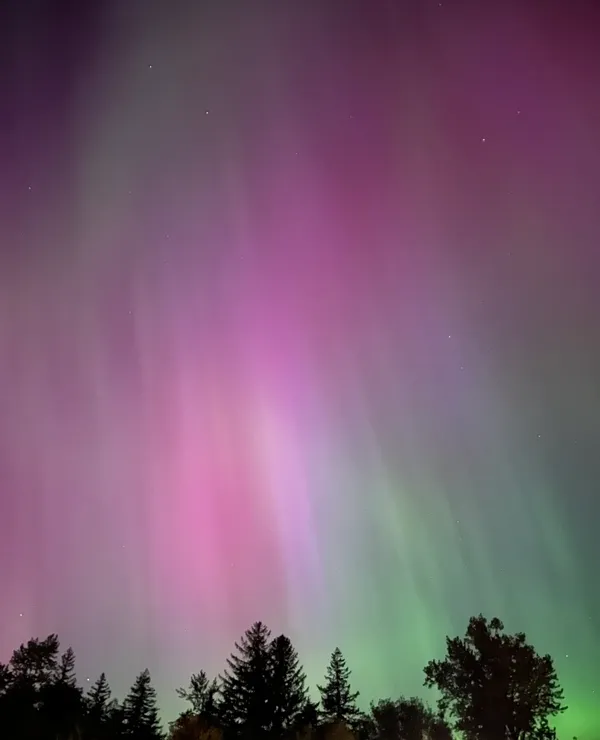
Parts of Massachusetts may have another opportunity to see the aurora borealis overnight Monday into early Tuesday, as charged particles from a recent solar eruption approach Earth and could trigger a significant geomagnetic storm.
The event follows an X-class solar flare from an active region on the Sun that also produced a coronal mass ejection, a large cloud of magnetized plasma. When a coronal mass ejection reaches Earth, it can disturb the planet’s magnetic field and expand the auroral oval farther south than usual, increasing the odds of visibility in mid-latitude locations such as New England.
How strong the storm could be — and why it matters for Massachusetts
Forecasts indicate geomagnetic conditions could reach levels categorized as strong (G3) and potentially severe (G4) on the commonly used G-scale for geomagnetic storms. If the storm peaks in that range and skies are sufficiently clear, auroral activity may be visible low on the northern horizon from darker locations across the state.
Aurora outcomes in Massachusetts depend on more than storm strength. The aurora becomes more likely when the incoming solar wind couples efficiently with Earth’s magnetic field, a factor that can change rapidly as the leading edge of the disturbance arrives. As a result, visibility forecasts can shift over the course of the evening and overnight.
Timing: when the best viewing window may occur
The highest likelihood for any visible display in Massachusetts is expected late Monday night into early Tuesday morning, with a potential peak after midnight. While the storm’s arrival time can be estimated, the most intense intervals often occur in bursts, meaning the most noticeable activity could be brief and intermittent.
Where to look and what observers should do
Choose a dark location away from city lights, with a wide, unobstructed view toward the north.
Allow time for your eyes to adjust to darkness and avoid bright phone screens.
Expect the aurora, if it appears, to look like faint gray or green bands to the naked eye; cameras often capture stronger colors than human vision.
Aurora visibility in Massachusetts typically requires stronger geomagnetic activity than in northern New England, making clear skies and low light pollution especially important.
Potential impacts beyond the night sky
Geomagnetic storms at the G3–G4 levels can affect technology and infrastructure. Impacts can include satellite irregularities, degraded high-frequency radio communications, and increased risk of navigation and positioning errors. Power systems can also face operational challenges during higher-intensity geomagnetic conditions, though outcomes vary widely depending on grid configuration and local ground conductivity.
For Massachusetts observers, the main variable remains whether cloud cover and storm intensity align long enough to produce a visible display before dawn.